
Core Technologies & Features
Permanent magnet synchronous motors are classified into two types:
- Interior Permanent Magnet Synchronous Motors (IPMSM, where Lq = Ld).
- Surface Permanent Magnet Synchronous Motors (SPMSM, where Lq> Ld).

SPMSM (Lq > Ld) utilizes rotor magnetic circuit asymmetry to form a magnetic reluctance torque, according to the motor torque formula.
To achieve maximum torque with minimum current, it’s crucial to fully utilize this magnetic reluctance torque. The current lead angle, denoted as β , is set when the maximum torque is required
Compared to conventional Sinusoidal Pulse Width Modulation (SPWM), 7-segment Voltage-Space Vector Pulse Width Modulation (SVPWM) has several advantages:
- It outputs a basic vector-symmetric, reducing harmonic components in the current
- The dispersed distribution of zero vectors minimizes current pulsation in the motor winding
- The dispersed distribution of non-zero vectors diminishes the jitter of the voltage space vector
In addition, the triple harmonic injection technology enhances the output voltage, reduces the motor current, minimizes overall losses, and improves efficiency
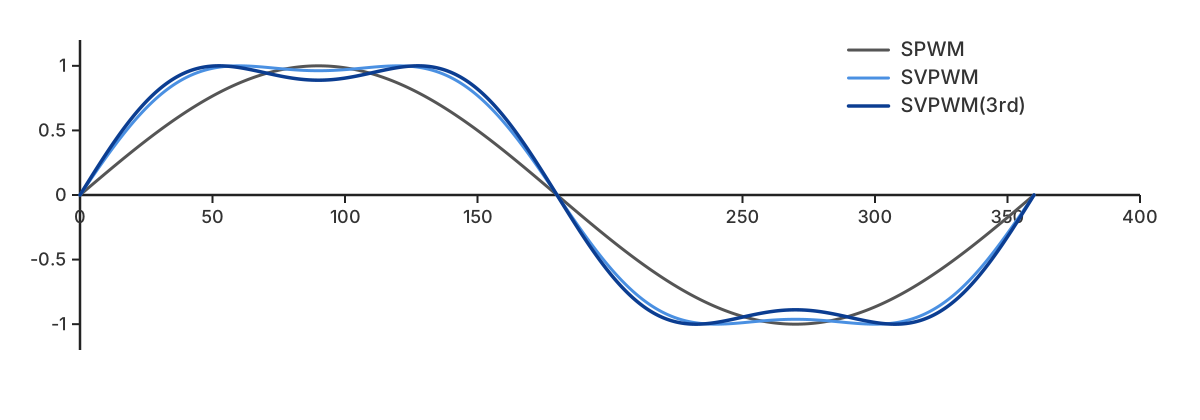
| Modulation System | Modulation coefficient | Line voltage peak value | Voltage utilization |
|---|---|---|---|
| SPWM | 1 | √3/2 · Udc | 86.6% |
| SVPWM | 1 | Udc | 100% |
| DPWM | 1 | Udc | 110% |
To maximize the DC bus utilization, enhance the compressor’s output power under high-speed weak magnetism, and expand the motor’s operating range, we use over-modulation technology based on Digital Pulse Width Modulation (DPWM). This not only smooths the motor current waveform but also ensures speed stability.
With a three-phase input voltage of 380V, a reactor voltage drop of 35V, and a bus voltage around 505V, the inverter outputs 372V. This results in a voltage utilization rate of 104%, further enhancing the system’s efficiency.
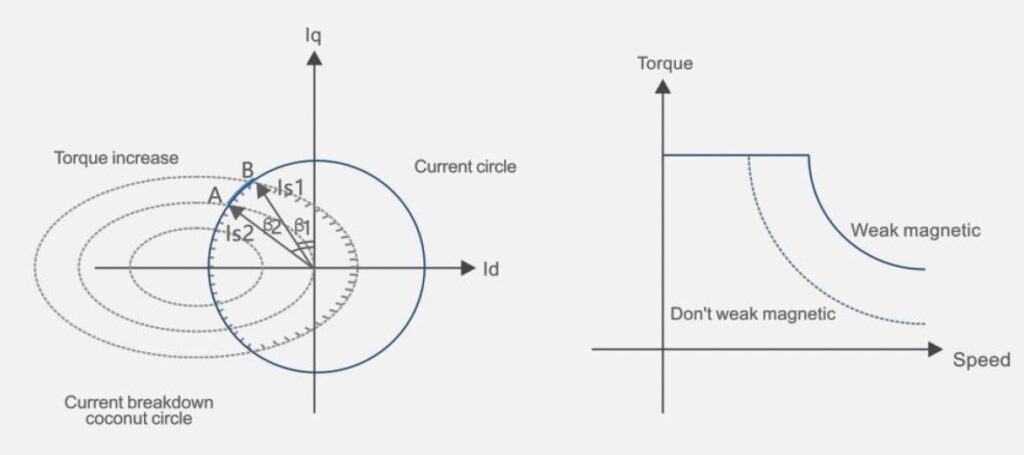
After entering the weak magnetic area, the angle B adjusts synchronously to ensure that the motor can operate at higher speeds and remain stable.
When the end voltage of the motor reaches its maximum, it can only operate by decreasing the excitation current and increasing its speed. The motor current consists of torque current (Iq) and excitation current (Id).
When the rotational speed increases from 1ωω to 2ωω, the stator current path transitions from B (Is 1) to A (Is 2), with the corresponding torque angles of β β 1 and β β 2, and β β 2 is greater than β β 1. As the speed increases and enters the weak magnetic area, the motor’s output torque reduces.
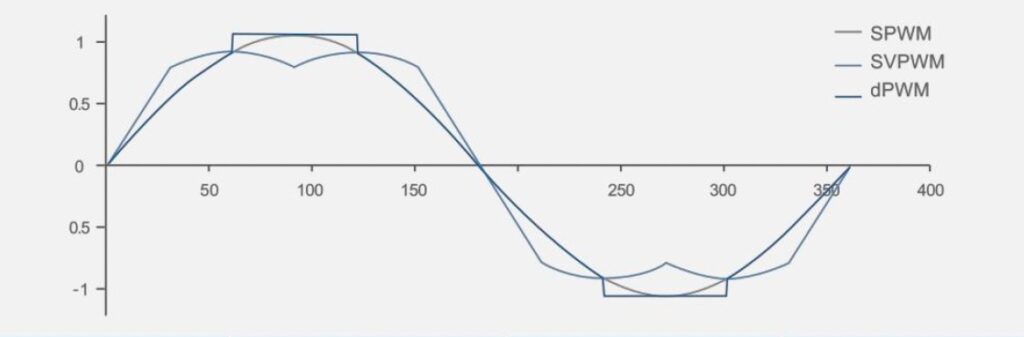
| Modulation System | Modulation coefficient | Line voltage peak value | Voltage utilization |
|---|---|---|---|
| SPWM | 1 | √3/2 · Udc | 86.6% |
| SVPWM | 1 | Udc | 100% |
| DPWM | 1 | 2Udc/π | 110% |
Single rotor compressor speed torque
Detects the load torque after startup and automatically applies the torque compensation to achieve a smooth transition. During the operation process, the matching torque compensation amount is automatically applied according to changes in the compressor load torque.
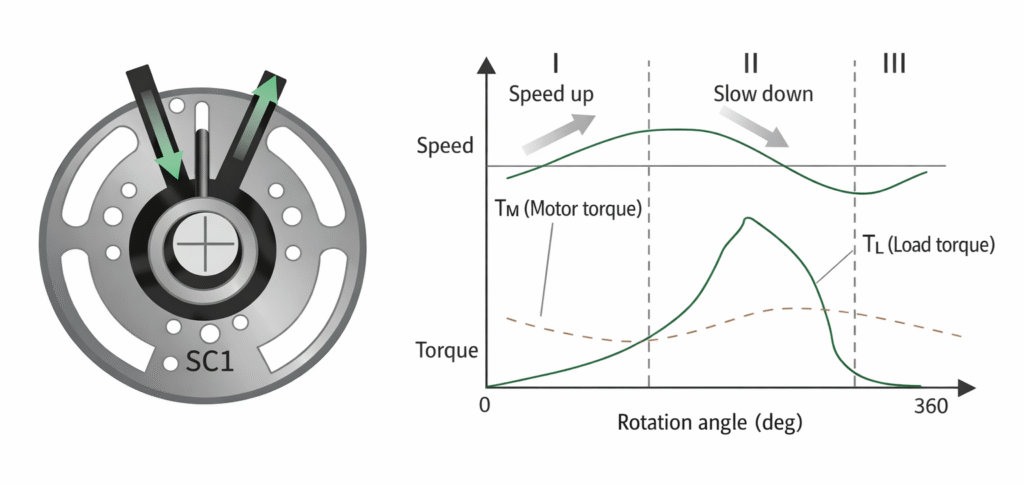
A single rotor compressor has only one cylinder, rotating once a week and once the exhaust process; the suction absorbs low-pressure gas, the exhaust is compressed high-pressure gas, so the rotation torque is not uniform.
The traditional constant torque control method outputs myopic constant motor torque within a week, which does not match the load torque, resulting in acceleration and deceleration in a week of rotation, as shown in the figure on the right, resulting in vibration and noise problems of the compressor.
Adaptive torque compensation technology breaks the conventional constant torque control output constant motor torque control method, according to the compressor in a week of load torque change, output matching motor torque, to ensure the uniform speed in a running cycle, inhibit the compressor speed fluctuations caused by load changes, to perfectly solve the problem of vibration and noise.
HIGH EFFICIENCY AND ENERGY SAVING
Permanent magnetsynchronous motor
Advanced Maximum Torque Per Ampere (MTPA) technology Adopted toobtain higher efficiency

Weakening magnetic control (Flux weakening) technology
Compressor runs to a higher speed and expand the speed rangeNo fluctuation of compressor speed and current in the weak magnetic areafast dynamic response

New space vector modulation & overmodulation technology
Combined with New space vector modulation & over modulationtechnology reduce the switching loss of the driver
Low frequency torque compensation technology
Thanks to low frequency torque compensation technology, the compressorcan operate stably at low-frequency, and the temperature controller is moreaccurate, more comfortable and energy-saving
RELIABLE QUALITY

Wide voltage range operation
- Single phase:140V-265V
- Three phase:304V-460V

Extreme ambient temperature operation
Reliable operation under ultra high 60° C and ultra low -30° C
Adaptive frequency limit and reduction

Perfect the fault protection function
Over high /low voltage, over current, over temperature, lightning,resistanceimpact and other protection
Let’s Talk About Your Project
Connect with one of our experts. We work with you to understand your specific requirements and offer a customized solution.